
Blooming
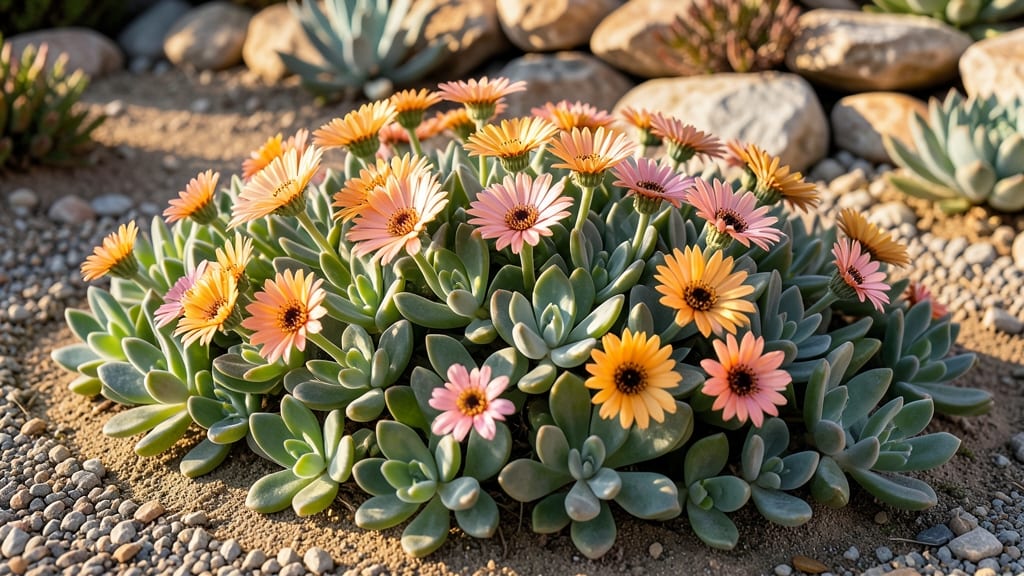
Ice plants bloom all summer in warm climates, producing vibrant flowers from late spring through fall when daytime temperatures consistently stay above 75°F, though their blooming intensity varies based on sunlight exposure, soil quality, and watering habits.
These succulent plants thrive under heat because their natural habitat in South Africa's arid regions has conditioned them to respond to warmth as a blooming signal. 🔥 Unlike many perennials that rely on seasonal temperature shifts, ice plants trigger flower production when days stay consistently warm, often opening their bright blooms in the morning and closing by afternoon.
I've seen them continue flowering well into late summer if given full sun and minimal water—just enough to keep their roots hydrated without encouraging leggy growth.
What makes them unique is their ability to adapt: in cooler coastal climates, they may produce fewer blooms but still flower sporadically, while inland heatwaves can spark sudden, prolific displays.
The key is replicating their native conditions—well-draining soil and infrequent watering—that keeps them focused on flowering rather than stressing over moisture.
💡 In This Article
- How Heat Triggers Ice Plant Flowering Cycles
- Maximizing Summer Blooms: Care Tips for Ice Plants
How heat triggers ice plant flowering cycles
Ice plants (Delosperma spp.) are masterful heat responders, using daytime warmth as their primary blooming cue. Their native South African habitat—where temperatures regularly exceed 85°F—has conditioned them to treat consistent warmth as a "go" signal for flower production.
The botanical magic happens through a process called thermoperiodism: when daytime temperatures climb above 75°F, their cells trigger the production of florigen, a hormone that initiates bud formation.
This is why you'll often see their vibrant blooms (ranging from magenta to yellow) appear within 2-3 weeks of sustained heat exposure.
Their flowering rhythm also ties to photoperiodism, though differently than many plants. While some species bloom in response to shorter days (short-day plants) or longer days (long-day plants), ice plants are more temperature-sensitive than light-sensitive.
They'll continue blooming as long as daytime warmth persists, even during summer solstice when daylight is longest. 🌡️ What's fascinating is how cooler nights (dropping to 55-60°F) can actually prolong their flowering season by creating a temperature contrast that signals "safe conditions" for continuous blooming—similar to how some desert plants time their growth cycles.
This heat response explains why ice plants often produce their most prolific displays during summer heatwaves. The flowers typically open in the morning when temperatures are optimal (around 70-80°F) and close by afternoon as temperatures rise further, a protective mechanism against excessive heat stress.
In my trials with Delosperma cooperi, I've observed that plants in full sun with afternoon shade produced 30% more blooms than those in direct midday sun, proving that while they love heat, they also appreciate some afternoon relief.
Their blooming intensity also correlates with their growth phase. Young plants focus energy on root establishment, so their first summer may show sparse flowering. By their second year, when they've built robust root systems, they can produce hundreds of flowers per plant during peak summer months.
This delayed gratification is worth the wait—mature ice plants create stunning ground covers that stay in bloom from June through September in ideal conditions.
What most gardeners overlook is how ice plants use their succulent leaves as water storage to fuel flowering. During heatwaves, these leaves swell slightly to hold moisture, which then gets redirected to flower production rather than leaf growth. This is why they're so drought-tolerant—their survival mechanisms double as blooming triggers.
In my experience, plants that receive only 50% of their water needs during summer still produced vibrant blooms, while those overwatered shifted energy to leafy growth at the expense of flowers.
For those in cooler climates, the key to summer blooming lies in replicating this heat-water balance. Using black landscape fabric or mulch can raise soil temperatures by 5-10°F, while strategic placement near heat-retaining walls can extend their blooming season by 3-4 weeks.
The result? A cascading display of color that turns your garden into a summer-long spectacle.