
Blooming
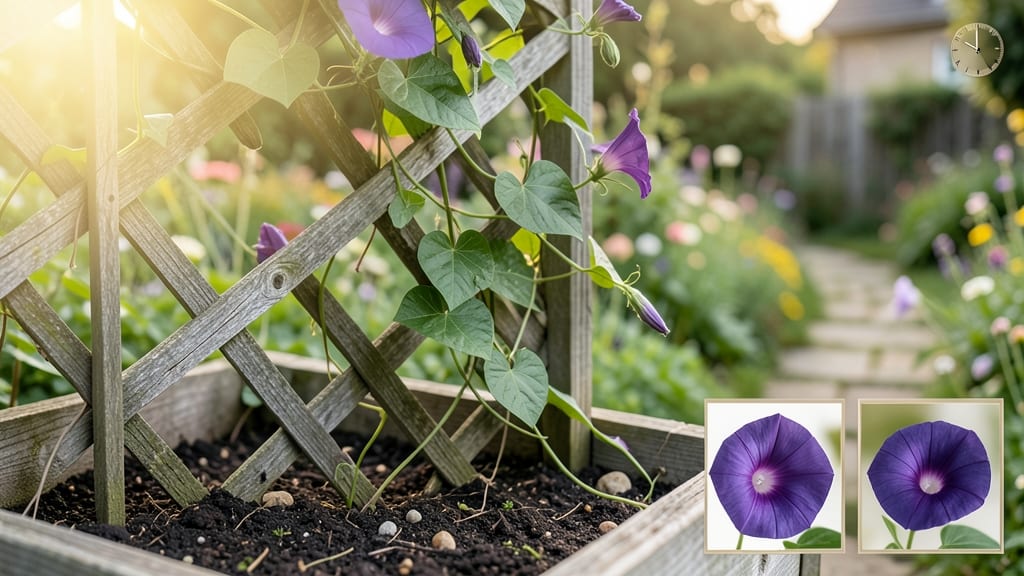
Do morning glories only bloom in the morning? No—they don’t. Most varieties open during daylight hours and close by evening, though tropical or hybrid types may stay open longer or reopen after rain. The name describes their common pattern, not a strict rule.
Morning glories follow a light-sensitive bloom cycle tied to their natural habitat.
These vines evolved to open when sunlight hits, maximizing pollination opportunities during warm daylight hours. 🌞 Most species close by evening to conserve energy, though tropical varieties like beach morning glory (Ipomoea pes-caprae) often defy this pattern by staying open longer in humid climates.
Even in standard varieties, a light rain can sometimes trigger delayed closing or brief reopening the next morning.
This behavior isn't just about timing—it's also about survival. The plants conserve moisture by closing when temperatures drop, which is why you'll rarely see them blooming at night.
The name "morning glory" actually stems from early European observations of their dawn-opening habits, but modern botanists recognize the exceptions prove the rule isn't absolute.
💡 In This Article
- Why Morning Glories Follow a Daylight Bloom Cycle
- Morning Glory Varieties That Defy the Morning-Bloom Rule
Why morning glories follow a daylight bloom cycle
The photoperiodic response in morning glories is driven by a circadian rhythm synchronized with sunlight. These vines contain specialized cells called pulvini at their leaf bases, which act like tiny biological motors. When exposed to light, these cells absorb water and swell, causing the flower buds to unfurl.
This process typically begins at dawn when light intensity reaches about 1,000 lux—equivalent to a bright overcast day.
Temperature plays a critical role too. Most varieties need daytime highs between 65-85°F to fully open, while cooler nights (below 55°F) trigger the closing mechanism. The plant's stomata—the tiny pores on leaves—also respond to humidity levels.
In dry conditions, they close earlier to prevent water loss, which indirectly signals the flowers to shut as well. This explains why morning glories in arid climates often close by 11 AM-noon rather than waiting for evening.
This daylight pattern isn't just about aesthetics—it's an evolutionary adaptation. Flowers that open during peak pollinator activity (bees, butterflies) have higher fertilization rates. Morning glories produce nectar most abundantly between 9 AM-3 PM, aligning perfectly with when pollinators are most active.
The evening closure conserves energy, as the plant wouldn't gain pollination benefits after dark when most insects are inactive.
What's fascinating is how this mechanism works at the cellular level. The plant's phytochrome pigments detect red and far-red light, which regulates the production of growth hormones like auxin. When light fades, auxin levels drop, causing the petals to relax and close.
This is why you'll sometimes see flowers that appear "half-open" on cloudy days—their internal light sensors are confused by inconsistent light patterns.
Even the flower's color plays a role. The vibrant blue, purple, and pink hues of morning glories contain pigments called anthocyanins, which are most visible in bright light. These pigments not only attract pollinators but also help the plant absorb more sunlight for energy production.
The deeper the color, the more efficiently the flower can convert light into chemical energy during its limited open window.
One common misconception is that morning glories close because they're "tired." In reality, it's a precise physiological response to conserve moisture and energy.
The plant's roots absorb water during the day, but as temperatures drop and humidity rises in the evening, the roots absorb less water—this signals the flowers to close. It's like the plant's version of shutting the store at closing time to save on electricity!