
Blooming
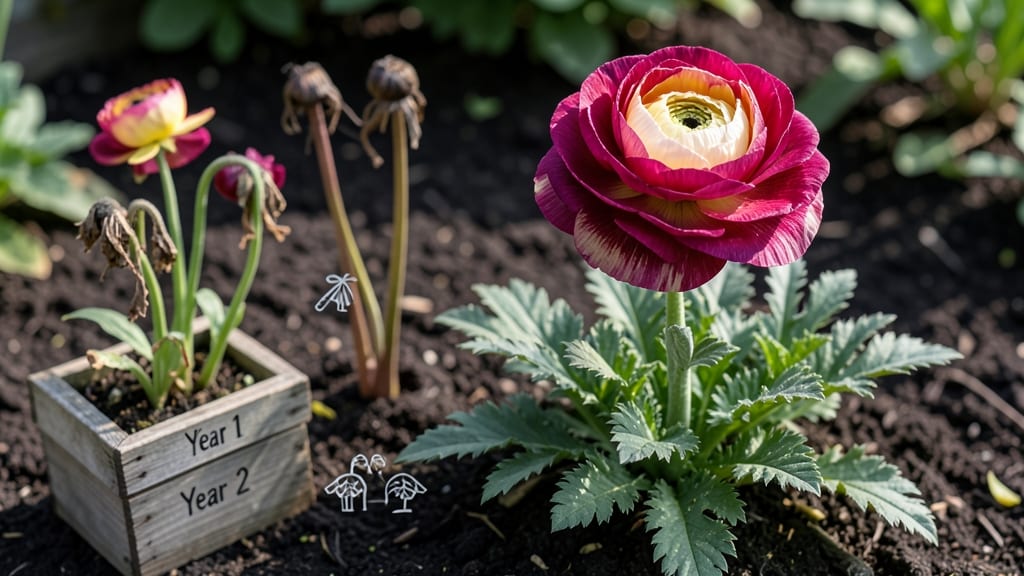
Do ranunculus bloom every year? They rarely do as true perennials in most climates—they typically die back in winter and regrow from corms, often producing flowers again only if conditions (like mild winters and well-drained soil) are ideal. Many gardeners treat them as annuals or replant yearly for consistent blooms.
Ranunculus rely on underground corms to survive winter, but these storage organs are highly sensitive to cold and moisture extremes. 🌱 In regions with harsh freezes or soggy soil, the corms may rot or fail to regenerate properly, forcing gardeners to replant fresh corms each spring.
Even in milder climates, consistent blooming depends on proper soil drainage and winter protection—like adding mulch—to shield the corms from temperature swings.
What makes this tricky is that ranunculus can look dead in winter but still hold potential. The key is giving them the right conditions: well-draining soil, minimal winter moisture, and protection from extreme cold.
Without these, you might end up with a "false perennial" that blooms beautifully one year but fades the next.
💡 In This Article
- Why Ranunculus Often Fail as True Perennials
- How to Maximize Ranunculus Reblooming Year After Year
Why ranunculus often fail as true perennials
Ranunculus behave more like tender perennials than true hardy ones because their survival hinges on delicate corms—thickened underground stems that store nutrients. These corms enter dormancy in late summer, becoming dormant until spring warmth triggers regrowth. The problem?
They lack the protective layers of true perennials like peonies, which have thick rhizomes or deep root systems. Instead, ranunculus corms are soft and porous, making them vulnerable to freezing temperatures below 20°F or prolonged soil moisture.
Cold sensitivity is the biggest hurdle. While some varieties tolerate 10-15°F for short periods, prolonged exposure causes cellular damage. The corms' outer skin can crack, allowing pathogens to invade.
In regions like USDA Zones 5-7, where winters dip below 10°F, gardeners often see only 30-50% reblooming success without protection. Even in milder zones, poor drainage turns winter into a death sentence—soggy soil triggers rot within weeks.
Soil conditions matter just as much as temperature. Ranunculus corms thrive in well-draining soil with a pH of 6.0-7.0, but heavy clay or sandy loam can trap moisture. A single heavy rain after planting can suffocate corms, while summer drought stresses them before dormancy sets in.
This is why many gardeners in Pacific Northwest or Mid-Atlantic climates treat ranunculus as annuals—they simply can't guarantee corm survival through winter's unpredictability.
What most people don't realize is that even healthy corms need 6-8 weeks of consistent cold exposure to break dormancy properly. Without this, they may sprout weakly or not at all.
In warmer climates like Zone 8+, corms can survive winters but often produce fewer blooms because the dormancy period is incomplete. This creates a paradox: too much cold kills them, but too little prevents reblooming.
Regional examples highlight the challenge. In Southern California, where winters rarely drop below 35°F, ranunculus may rebloom reliably—but only if planted in raised beds with gritty soil. Meanwhile, in New England, gardeners must lift and store corms indoors during winter or risk total loss.
The corms' fragility means they're caught between needing cold to trigger growth and freezing to survive it.
Here's the botanical kicker: ranunculus corms contain high starch reserves that fuel rapid spring growth, but these reserves deplete faster in poor conditions. A corm that's only 50% viable at planting will either fail to sprout or produce just a few weak stems.
This is why commercial growers often sell corms in graded sizes—larger corms have more stored energy to weather winter stresses.
Understanding this helps explain why ranunculus often look dead in winter but may still hold potential. The corms aren't always gone—they're just waiting for the right conditions to wake up. But without proper care, that potential becomes a gamble. 🌱