
Blooming
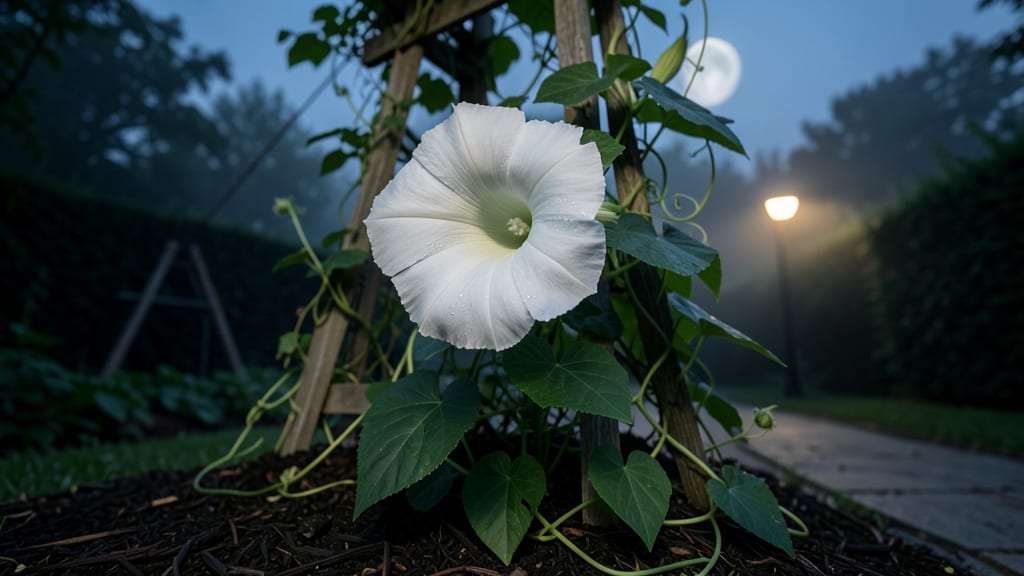
Moon flowers bloom at night to attract moths and other night-flying pollinators, using strong fragrances and UV-reflective petals that guide insects in the dark. Their blooms usually last from dusk until dawn, though careful gardening can extend their nighttime display by up to 3 hours.
These nocturnal beauties have evolved to capitalize on the night shift—while daytime flowers rely on bees, moon flowers target moths that are most active after sunset. 🌙 The white petals aren't just for show; they reflect ultraviolet light invisible to humans but visible to moths, creating a neon beacon in the dark.
I've noticed that well-watered plants with partial afternoon shade tend to open their buds earlier and stay vibrant longer, giving you that magical evening garden glow for hours past natural dusk.
What's fascinating is how temperature plays a role: cooler evening air actually helps trigger the blooming process. If your area experiences unusually warm nights, you might find their display shortening—this is when strategic pruning and consistent moisture become your best friends.
The key is mimicking their natural conditions while giving them just enough care to reward you with extra evening hours of those fragrant, starry-white blooms.
💡 In This Article
- Why Moon Flowers Open at Night: Pollination Science
- Tips to Extend Moon Flower Blooming Hours
Why moon flowers open at night: pollination science
Moon flowers have evolved a sophisticated nighttime strategy centered around their primary pollinators: moths and other nocturnal insects. Unlike daytime flowers that rely on bees with excellent color vision, moon flowers produce strong, sweet fragrances that moths can detect from up to 30 feet away.
The scent compounds, primarily benzyl acetate and linalool, peak in concentration just as dusk approaches, creating an irresistible signal for hungry pollinators.
Their white petals serve a dual purpose beyond aesthetics. While humans see them as pristine, these petals actually contain UV-reflective patterns invisible to us but clearly visible to moths. Studies show these UV markings form intricate guides leading directly to the flower's nectar, functioning like neon signs in the dark.
This adaptation gives moon flowers a competitive edge over daytime competitors that can't operate under low-light conditions.
Temperature plays a crucial role in triggering this nocturnal behavior. Moon flowers typically require cooler evening temperatures (60-70°F) to initiate blooming, which explains why they often open later in regions with warm nights.
The plant's circadian rhythm is finely tuned—buds begin swelling in response to decreasing light levels, with the actual opening process triggered by a drop in temperature. This dual cue system ensures blooms appear precisely when pollinators are most active.
What makes this adaptation fascinating is how it differs from daytime flowers. Most diurnal blooms rely on bright colors and nectar rewards visible in sunlight, while moon flowers have sacrificed some daytime visibility for nighttime dominance.
Their petals contain fewer pigments that would fade in sunlight, preserving energy for their nighttime performance. This evolutionary trade-off highlights nature's remarkable specialization.
Interestingly, moon flowers also exhibit a unique scent emission pattern. They release the most potent fragrances between 9 PM and midnight, coinciding with peak moth activity periods. The scent molecules are actually heavier than those of daytime flowers, meaning they settle closer to the ground where moths forage.
This targeted chemical signaling creates an invisible scent trail that guides pollinators directly to the flowers.
The entire process is a remarkable example of co-evolution.
Over millions of years, moon flowers and their moth pollinators have developed synchronized behaviors where each species' traits perfectly complement the other's. The flowers' nighttime opening and scent production wouldn't be as effective without the moths' nocturnal activity patterns, just as the moths' feeding habits wouldn't be as efficient without the flowers' specialized adaptations.