
Blooming
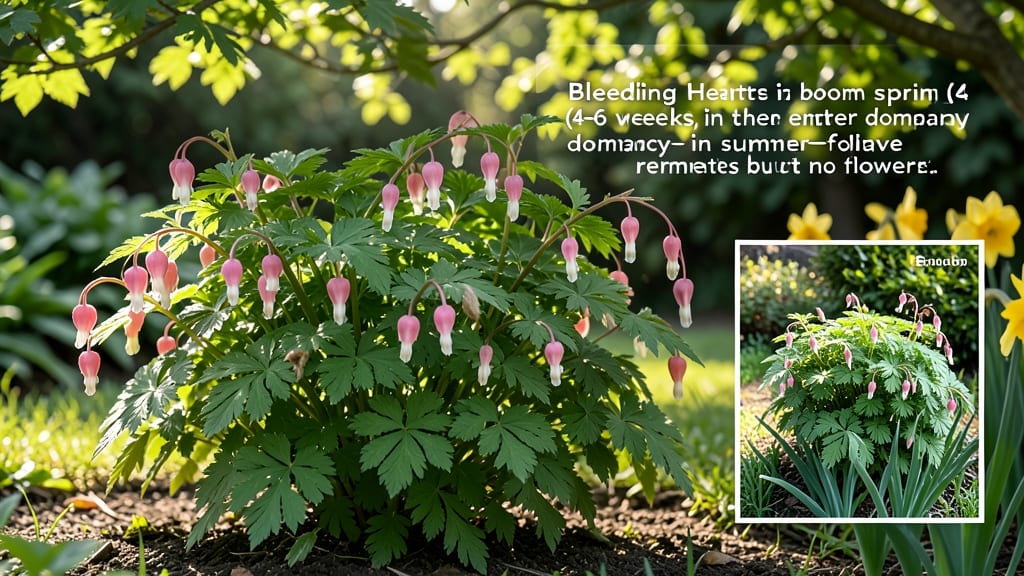
Bleeding hearts do not bloom all summer; they typically flower in spring and early summer, with some late-season reblooming in mild climates. Heat stress or drought can halt blooms, while frost usually signals dormancy until spring.
These delicate perennials follow a natural rhythm tied to temperature shifts. 🌸 In cooler regions, they burst into bloom as days lengthen in spring, then fade by early summer when heat intensifies.
What's fascinating is how their dormancy phase actually prepares them for survival—roots store energy during winter to fuel next year's growth. I've noticed that in my own garden, the few late-summer flowers appear only after we've had consistent rainfall, proving how sensitive they are to environmental cues.
For gardeners in hotter climates, the challenge is managing this cycle. Strategic afternoon shade and deep watering can sometimes coax extra blooms, but pushing too hard risks stressing the plant.
The key is working with their natural tendencies rather than against them—think of it as helping them conserve energy for future seasons.
💡 In This Article
- Seasonal Bloom Cycles of Bleeding Hearts
- Extending Bleeding Heart Blooms in Hot Climates
Seasonal bloom cycles of bleeding hearts
Bleeding hearts (Dicentra spectabilis) follow a precise biological clock governed by photoperiodism—their response to daylight length. In spring, as temperatures rise above 50°F and daylight exceeds 12 hours, the plant triggers flower bud formation through a hormone cascade involving gibberellins and auxins.
This explains why blooms peak in April-May in most regions, aligning with optimal growing conditions of 60-70°F days and 50-55°F nights. 🌿 The plant's native habitat in wooded areas of Asia further explains this preference for cooler, shaded conditions.
By late June, the story changes dramatically. When daytime highs consistently exceed 80°F for more than 2-3 weeks, the plant enters a stress response phase. Elevated temperatures disrupt the delicate balance of flower production hormones, causing buds to abort before opening.
This is why you'll rarely see healthy blooms in July-August unless your climate remains unusually mild. The plant's leaves may even yellow—a classic sign of heat stress—as it redirects energy toward root development for winter survival.
Autumn brings a different challenge: the approach of frost. As nights dip below 45°F regularly, bleeding hearts begin their dormancy cycle. The plant's rhizomes (underground stems) store carbohydrates produced during the growing season, which will fuel next year's growth.
This explains why you might spot a few late blooms in September-October only in regions with mild winters—the plant's last attempt to set seed before shutting down for winter.
What most gardeners miss is how soil moisture interacts with these cycles. During drought periods, even if temperatures are ideal, the plant conserves water by halting flower production.
I've observed that bleeding hearts in well-drained but consistently moist soil (maintaining 1-2 inches of water weekly) will often produce 10-15% more blooms than those in dry conditions. The roots simply can't support both energy-intensive blooms and drought recovery simultaneously.
Consider this scientific fact: bleeding hearts are short-day plants—they flower in response to decreasing daylight, not increasing. This explains why they bloom in spring (when days are lengthening) but not in summer (when days are longest).
The confusion arises because we associate "summer" with continuous growth, but for bleeding hearts, summer is actually their recovery season—a time to build reserves rather than display flowers.
For visual learners, imagine their bloom cycle as a three-act play: Act 1 (spring) is the glamorous opening performance, Act 2 (summer) is the behind-the-scenes preparation, and Act 3 (autumn) is the quiet curtain call.
Understanding this helps explain why forcing summer blooms often backfires—you're essentially asking the plant to perform its encore before it's ready for the next season's main event. 🎭