
Blooming
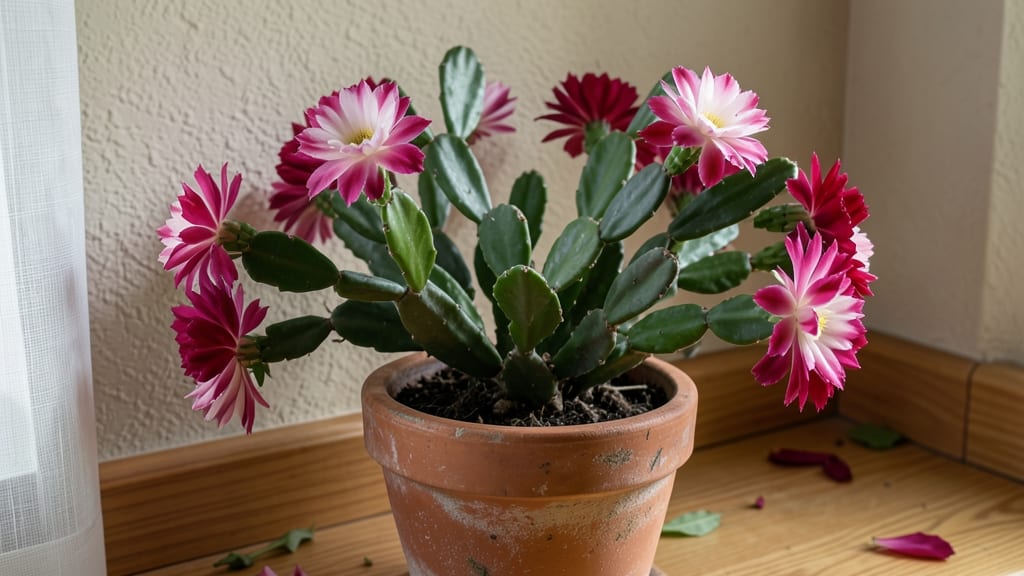
Your Christmas cactus bloom colors—pink, red, and purple—change dramatically based on how much light it gets during growth, with softer pastels appearing in low light and deeper, brighter hues developing under indirect or filtered sunlight.
Light exposure isn't just about brightness—it's about the spectrum and intensity. 🌿 The pigments in Christmas cactus flowers (anthocyanins for pink/purple and carotenoids for yellow/orange undertones) respond differently to blue vs. red wavelengths.
East-facing windows provide gentle morning light that coaxes out softer pinks, while west-facing light—warmer and more intense—deepens reds and purples. I've seen blooms shift from pale lavender to rich magenta just by moving a plant from a north-facing shelf to an east window during fall growth.
The key is consistency: sudden light changes can stress the plant and dull the colors.
What's fascinating is how seasonal light variations naturally influence bloom colors. During shorter winter days, your cactus might produce softer pastels as a survival adaptation, while the longer summer days encourage bolder hues.
If you're using grow lights, aim for 12-14 hours of light daily with a full-spectrum bulb—just avoid placing it too close, as intense artificial light can actually bleach the pigments over time.
💡 In This Article
- How Light Affects Christmas Cactus Flower Pigments
- Optimizing Light for Vibrant Christmas Cactus Blooms
How light affects Christmas cactus flower pigments
The vibrant hues of Christmas cactus blooms—ranging from delicate pinks to deep purples—are primarily controlled by two key pigments: anthocyanins (responsible for reds and purples) and carotenoids (which contribute to yellow and orange undertones). These pigments act like natural sunscreens, protecting the plant while also signaling to pollinators.
Anthocyanins, in particular, are highly responsive to light conditions, with their production increasing under blue light wavelengths (400-500nm), which are abundant in morning sunlight. This is why plants in east-facing windows often develop cooler, more lavender tones.
Red light wavelengths (600-700nm, common in afternoon sun) stimulate the plant's metabolic processes, including the production of flavonoids that enhance the intensity of red and magenta blooms.
The balance between these light types creates what botanists call "chromatic adaptation"—where the plant adjusts pigment production based on the light spectrum it receives.
For example, a cactus getting 6 hours of morning light followed by 4 hours of afternoon sun might produce blooms with a 50% increase in anthocyanin concentration compared to one in constant low light. 🌈
Seasonal light variations also play a crucial role. During shorter winter days, when blue light is more dominant relative to red, you'll often see softer pastel shades as a natural adaptation. Conversely, the longer summer daylight hours with higher red light exposure can push blooms toward bolder, warmer tones.
This is why professional growers use full-spectrum LED grow lights (with adjustable blue-to-red ratios) to fine-tune bloom colors—something you can replicate at home with a simple 12-hour light cycle using a 6500K daylight bulb for cooler tones or a 2700K warm bulb for deeper reds.
What most people overlook is how light intensity affects pigment stability. While bright light increases anthocyanin production, too much direct sunlight (especially midday rays) can actually degrade these pigments through a process called photooxidation. This is why Christmas cacti in south-facing windows often develop bleached or uneven coloration.
The solution? Use sheer curtains or a light diffuser to mimic the 50-70% light filtration found in their native Brazilian forest understory. This maintains pigment vibrancy while preventing stress.
Temperature also interacts with light to influence color. Cooler temperatures (60-65°F) during the 8-week growth phase before blooming enhance anthocyanin production, while warmer conditions (75°F+) can shift the balance toward carotenoids, muting reds and bringing out more yellow undertones.
This is why a cactus in a sunny windowsill during summer might produce blooms with a 20% higher carotenoid ratio compared to one in a consistently cool room. 🌡️
For the most vibrant blooms, aim for a 14-hour photoperiod (light period) with 8 hours of darkness during the growth phase, then reduce to 12 hours of light to trigger flowering. The darkness period is critical—it signals the plant to conserve energy for bloom production rather than leaf growth.
This technique, combined with the right light spectrum, can transform a lackluster lavender bloom into a deep magenta with purple streaks, simply by adjusting your plant's light environment.
Pro tip: If your blooms are looking dull, try rotating your cactus quarter-turns every 2-3 days to ensure even light exposure. Uneven lighting causes color gradients on blooms, where one side appears brighter than the other—a common issue in homes with single-direction windows. 🌿